HomeTechnology
How a Tufo is made.
Four constructions, a dozen compounds and plies, and a casing whose thread count is written as two numbers. Here is what the words on the product pages mean.
What changes is how the tyre holds on to the rim.
A tubular and a tubular tyre are built the same way: a closed torus. Only the fixing to the rim differs. The tubed clincher and the tubeless ready are open, and hook on by their beads.
 Road · track · cyclo-cross · MTB · para-cycling · indoor
The tubular
A tyre closed on itself, stitched around its inner tube, with a cotton base tape for gluing. It is fitted with Tufo double-sided tape or with glue, on a tubular rim.
Its advantages in racing: higher pressures than a clincher, no possible pinch puncture, and above all safe behaviour in a puncture — the tubular stays on the rim, the wheel stays stable, and you can ride a few hundred metres flat to get home.
Repair does not mean removal: you inject Tufo sealant through the valve.
 Road · track — “C” references
The tubular tyre
A Tufo patent: the same closed tubular, but edged with a profiled rubber bead. It fits on an ordinary clincher rim, with no glue, no rim tape, no tools. When inflated, the bead blocks spread and lock under the rim hooks: the tubular neither rotates nor comes off.
You keep the behaviour of a tubular without buying tubular wheels. The S33 Pro, Hi-Composite Carbon and Elite Ride exist in this version, recognisable by the “C” before the name.
 Road — Calibra Plus, Comtura Duo and Aero
The tubed clincher
An open tyre with folding beads, fitted with an inner tube on a hooked rim. The most widespread construction and the easiest to repair at the roadside.
At Tufo, tubed road tyres take over the compounds of the tubulars: SPC Silica for the tread, Vectran barrier on the Comtura, and a rubber puncture strip under the rubber.
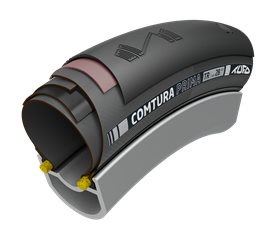 Road · gravel · MTB — hookless compatible
The tubeless ready
An open tyre whose inner rubber, made of nano-blocks, holds air without a tube. It is fitted with liquid sealant, which finishes the airtight seal and plugs small punctures as you ride. The beads are aramid, treated to stay in place — which matters on hookless rims.
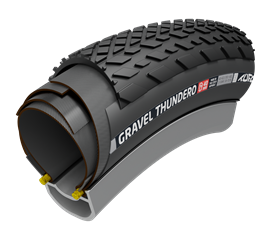
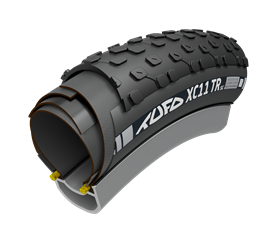
This is the construction of the Comtura TR, the Endurance 7 TR, the three gravel tyres and the XC TR SG. The gravel and XC tyres add nylon-reinforced sidewalls, and an HD version with a thicker casing.
The six layers of a Tufo tubular.
From the outside in. TR tyres follow the same logic, without the base tape or the tube: it is the airtight inner rubber that replaces them.
- TreadThe rubber that touches the road: activated silica, nanostructured silica or carbon black depending on the model and use.
- Rubber puncture stripA layer of rubber under the tread: whatever passes through the rubber stops there before reaching the casing. Tufo calls it the “protective rubber ply”.
- Composite puncture-protection beltRubber and fibres — or Vectran on the models that have it — placed under the tread, where flints get through.
- CasingPlies of threads that overlap under the tread: that is why Tufo writes TPI as two numbers, sidewall then under the tread, such as 210/375.
- Base tapeCotton, which takes the tape or the glue evenly all round the tubular.
- Inner tubeButyl: low air permeability, and less rolling resistance than a separate tube.
Tubeless ready is not the same everywhere.
The same principle — an airtight inner rubber and aramid beads — but a construction adapted to what the tyre has to take: pressure on the road, cuts on gravel, impacts on the MTB.
Why two numbers, and which one to look at.
TPI counts the casing's threads per inch. At Tufo, the first number is the sidewall's, the second that of the zone under the tread, where two plies overlap. A 60/90 is a training casing, robust and stiff; a 210/375 is the standard race casing; the 400/400 of the Elite cyclo-cross tubulars, the 400/600 of the Track Pulse and the 400/665 of the Comtura Prima TT are the most supple in the catalogue.
The finer the casing, the more the tyre follows the ground, the more comfortable and fast it is — and the more attention it needs against cuts. That is exactly the trade-off between a Cubus SG, a Flexus Cubus and an Elite Cubus: same pattern, three casings.
The HD casing of the gravel tyres, 130/255, goes the other way: thicker, fewer fibres, for heavy loads and higher pressures.
The glossary of the product pages.
Each page lists what the tyre carries. Here is what each name means, as Tufo describes it.

Standard puncture protection
An extra layer of rubberised casing under the tread: a barrier sufficient against most punctures, without hurting efficiency.
On 21 models
Vectran barrier
The toughest material in the Tufo catalogue: a Vectran ply, a liquid-crystal polymer five times stronger than steel at equal section, against punctures, cuts and blowouts.
On 9 models
Composite puncture-protection belt
A composite belt of rubber and fibres laid under the tread, which allows a thinner tread — hence better efficiency — without losing resistance.
On 6 models
Rubber puncture strip
A layer of rubber laid under the tread: whatever passes through the rubber stops there before reaching the casing. It adds to the model's puncture barrier, it does not replace it. Tufo calls it the “protective rubber ply”.
On 14 models
SPC Silica compound
Tufo's reference road compound: 66 Shore A, a blend of natural and synthetic rubbers loaded with activated silica, for wet grip and low rolling resistance.
On 12 modelsLPS Silica compound
Natural rubber compound loaded with activated silica, 63 Shore A: softer than SPC, for comfort and grip in cold weather.

Grip Silica compound
Tread compound with nanostructured silica, tuned for each discipline. Its strength is grip, especially in the rain.
On 20 models
Liquid Rubber casing
Casing compound of liquid rubber and nanostructured silica, with low hysteresis: it is what gives the top-end models their efficiency.
On 5 models
Low Modulus compound
Low modulus and high tensile strength: a supple compound that follows the ground, designed for road and track.
On 5 models
Airtight TR compound
Inner compound of nano-blocks, built into the casing, which holds air without a tube. It is what makes a tyre “tubeless ready”.
On 13 models
Aramid beads
Aramid beads treated to stay firmly in place in the rim, developed for tubeless and for safety on hookless rims.

Carbon Black compound
The training compound, proven over the years: high carbon-black content, high mileage, cut resistance.
On 7 models
Oil Silica compound
Soft compound (55 Shore A) for MTB and cyclo-cross tubulars: a share of oil in the activated-silica blend, for traction and comfort.
On 7 models
Nano Silica compound
Indoor-track compound, for speed, grip and responsiveness on wood. Not to be used in the wet.
On 2 models
BIC Silica compound
Compound for parquet and plastic floors (cycle ball, artistic cycling, wheelchair): grip, responsiveness, and no mark left on the floor.
On 3 models
Nylon-reinforced sidewalls
A nylon ply on the sidewalls of gravel and XC tyres: protection against cuts and stability at low pressure.
On 14 modelsSide Skin sidewall protection
A very light composite ply of rubber and polyester laid on the sidewalls: it extends their durability without weighing the tyre down. Tufo calls it “Side Skin”.
On 1 modelHD casing
130/255 TPI casing with thicker fibres: for heavy loads, higher pressures and aggressive terrain, for about thirty grams.

Kevlar reinforcement
Aramid fibre added to some road models: tensile strength and a supple structure, for durability and hold.

Fitting with Tufo tape
The tubular fits on Tufo double-sided tape: no drying time, no fumes, and a red guide strip for centring the tubular.
On 4 models
No pinch flats
Without an inner tube, an MTB tubular cannot get a pinch puncture against the rim: you can ride at lower pressure.
On 4 modelsGuaranteed maximum weight
The weight on the label is a guaranteed maximum, not an average.
The right tyre is first the right construction.
Then the width, then the compound. The catalogue filters in that order.